
On a night such as this one, Jesus said ‘do this in remembrance of me.’
All three readings tonight speak to a ritual which either informs our present practice or is our present practice. In our first reading (Exodus 12:1-4, 11-14) we see The Jews being commanded to keep repeating the story of the Passover which today thousands of years later they repeat with their children every Friday night at the Seder meal. In the second reading, (1 Corinthians 11:23-26) it is what we the followers of Christ continue to do today, 2000 years after his death. It is what has been handed down from the first disciples through the early Church, where we recall the crucifixion and resurrection of Jesus, as we like them, break bread. In our gospel reading (John 13:1-17, 31b-35) we have the washing of feet which is only recorded in the gospel of John, Do this in remembrance of me, was not repeated here, but this very embarrassing, uncomfortable and humbling practice that has changed a lot through the ages has remained with us as a Maundy Thursday practice. It seems many things happened on that night before the crucifixion, as it is also the time when it is recorded that Jesus commanded his disciples to love one another as he loved them. That is where Maundy Thursday got its name. – Maundy comes from Mandatum – the latin for commandment. In many churches they have a love feast that accompanies the washing of feet, our love feast, however is sharing in the cup of wine.
Our reading of 1 Corinthians rests with me. I very often feel that we participate in the Eucharist but it has somehow lost its deeper meaning to us. We do not come with passion nor do we leave with a passion to be and to do. So, tonight as we commemorate that first Eucharist I ask, What does it mean to us? Yes we assemble in the name of God and in fellowship with one another – united as one, to eat and drink in the Holy sacrament. What happens or is supposed to happen? How do we feel? Does it make any real difference to us?
Elisabeth 1 when pressed to say whether or not she believed the bread and wine to be the actual body and blood of Christ, she said the following words.
“Christ was the word that spake it. He took the bread and brake it; And what his words did make it That I believe and take it”. For most of us we don’t question the significance of the ritual, we just participate. Some believe that it feeds our spiritual souls as food feeds our physical bodies. I challenge you to consider well what you think and why as you eat the flesh of Jesus and drink his blood. How you understand it makes a difference in, if, and how it transforms you, and if, and how you express Christ to others.
It is important that we have a clear understanding of who is in attendance at the Eucharist. We must understand that Jesus is present at every Eucharist. He is the presider. The priest acts as the head of the body Christ, and he represents him. He, the priest that is, brings the bread the wine, our lives and joins them to the sacrifice of Jesus, offering them to the Father. Thus as Christ is presented to us in the body and blood, – our spiritual nourishment, he is also present as the person presiding at the mass.
This spiritual nourishment is not to be taken as if one is entitled to it, but as the opening prayer says we confessing our sins are made worthy of offering our souls and bodies as living sacrifices. We see here that we come to the table with a contrite heart. In the Eucharist before we taste of the banquet, 5 times do we acknowledge together our contriteness: in the opening prayer, the prayer of purity, the kyries, the general confession and in the Agnus Dei – that is the ‘O lamb of God’. It’s a contriteness understood that we are all equal, not as a donkey views the world, but as members of the family of God – none greater than the other. Some may have more resources, but we are all one in the sight of God – one human race. Each deserving of the same dignity as the next person. Galatians 3: 27 and 28 read from the VOICE says, “because all of you who have been initiated into the Anointed One through the ceremonial washing of baptism have put Him on. It makes no difference whether you are a Jew or a Greek, a slave or a freeman, a man or a woman, because in Jesus the Anointed, the Liberating King, you are all one.”
I’ll go further to stress that our oneness, is a foundational truth of our faith, which if we fail to embrace we cannot truly practice ‘Christness’ Christianity and Christlikeness. In the beginning God made us in his image and gave us God’s life. God never gave some and not others. Thus it means that we are all children of God, all equal in God’s sight, deserving of the same dignity and ‘equalness’. Some have just not acknowledged it. It’s our job as Christlike people to bring them into fellowship with the creator.
On the night Jesus broke bread and gave each disciple a piece. In our Eucharistic prayer this is celebrated in the fraction, that is when the priest breaks the bread and says “we break this bread to share in the body of Christ”. This is a goose pimple moment. I look in awe every Sunday as those words or the equivalent are said and the meaning washes over me. I understand it as ‘the body of Christ broken for the body of Christ’. The first body is the person Christ who in giving of himself was broken for us. The second body is the one family of God united in Christ. For me it also represents our brokenness which is being made whole through the body and blood of Christ. It represents the brokenness of the world which we go to love and serve in the name of Christ.
On the night Jesus took the cup of wine and gave each of them a sip from the same cup. We have no record that they dipped the bread in the wine. They did not scorn each other, they did not consider whether or not they would catch a germ or give their germs to others. They drank trusting God that they were all brethren and family. I wish we would all let the 18% alcohol cleanse us with the fire we feel when it goes down our throats. Drinking from the one cup brings also a humility, which our gospel reading introduces us to. The kind of humility that caused Jesus to wash the feet of the disciples.
You know washing of feet we are told were for the lowliest slave. Have you ever thought about how filthy their feet were. Their roads were not paved, animals were there only form of transport and there would be droppings as the animals went from one place to another. When dry and powdery they walked in it, when rain fell it spattered all over even they were able to avoid walking in it. To wash those sandaled feet was yucky! But Jesus did not ‘skin up’ his face, scorn or turn up his nose. He did the job showing us that we too are called as his servants to forget about ourselves and get down and dirty for his sake.
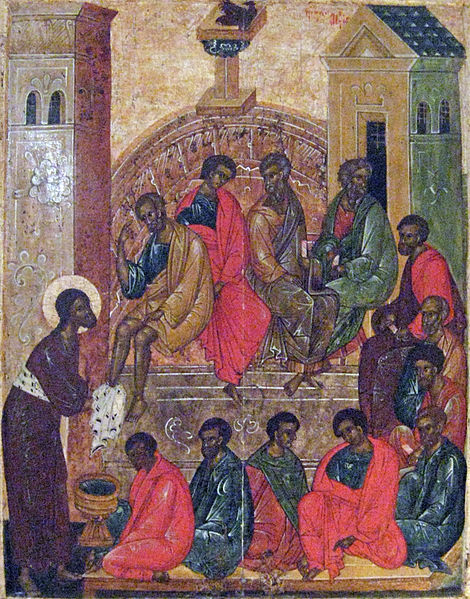
Jesus Washing the Feet of the Disciples http://kudzumonamour.blogspot.com/2014/04/its-black-jesus-part-four-last-supper.html
I shared the following with my students at CTC about 3 weeks ago and I think it becomes relevant today because humility is not a word we use very often these days. Humility for a long time has been a bad word to me. Humility, is very often used in relation to persons wanting others to play dead and roll over, or to be subject to them. One dictionary said ‘humility is the quality of having a modest or low view of one’s importance’. And to top that ‘it gave poor self-esteem as a synonym’. But that is not true. That’s not God’s message to us. That is not who we are in Christ. Humility is not sucking up to anybody or being a door mat. Humility is a quality that Jesus highly admires, one he himself exhibited. He emptied himself. Though he was God he never sought equality with God while on earth. He never thought himself too high to give his life so that humankind could be better. He washed the stinky feet of his disciples.
Humility is about being your authentic true self in Jesus Christ. It is being unpretentious and comfortable with who you are in Christ and seeking to build others up, and not yourself. It is recognizing in the misfortunes of others – there go I but for the grace of God. It is being grateful of one’s ability to walk in God’s grace, love, and forgiveness. It’s what the Eucharist should do for us as well.
When you participate in the Holy Communion and the service how do you feel? Do you leave Church as you came? What does this do for you? Do you come to Church thinking that you are going to leave refreshed? Do you become absorbed in the singing, the readings and prayers? Do we look on it as communing with God along with our brothers and sisters? Do we ever consider that we are worshipping God with Jesus sitting at the table with us? Do we consider that we have been cleansed, forgiven, imperfect yet holy and set apart for the work God has assigned us to do? Do we feel at one with the divine and so are able to do as the Priest says, to go in peace and serve the Lord? Are we thanking God for his continued grace and mercy and committing to continue in righteousness, that is, right living? Is it a weekly renewal of our covenant with Christ, a covenant which was made at our baptism, where we promise to carry on God’s work to love as he loved us, to serve all people and to live in faith until his coming again?
The hymn ‘Here O my Lord I see thee face to face’ helps us understand with these verses, the gist of which are:
This is the hour of banquet and of song;
The heavenly table spread;
We feast, and in feasting, prolong
The hallowed hour of fellowship with Jesus and God.
Ours is the sin, but the righteousness is God:
Ours is the guilt, but the cleansing blood is Jesus;
Our robe, our refuge, and our peace;
Jesus Blood, and righteousness.
When we rise; the symbols disappear;
The feast, but not the love, is past and gone.
The bread and wine removed;
but Jesus is still here, we have a foretaste of the festal joy.
This love and Joy, this sweet foretaste cannot be truly felt if we come to the table like the Pharisee in our self-righteousness; with an attitude that does not acknowledge that we are not worthy to be at the table, but are only there because we are redeemed by Jesus. We must come as the publican! As the confession says ‘being sorry for things done and left undone’. Things not done as they should have been done in the first place, like those times when we get defensive. We should come to the table humbly and available to God to be transformed. We should come and put aside everything else, to revel in the Lord. We should forget about ourselves and concentrate on God, so God is able to reveal Godself to us. Then and only then are we able to go home week after week, living a better life. A life passionate about practicing intentional and deliberate discipleship. Our assurance of pardon makes us joyful, our feast makes us whole and at peace with ourselves and the world.
Participating in the Holy Communion we see does 4 things for us as we are transformed:
- it unites with all other Christians and provides us with a pledge of glory to come;
- it provides us with spiritual food;
- it separate us from our sins;
- last but not least we commit to serving others with dignity through love mercy and peace.
Thus participating in the Holy communion brings to mind and reflection, what Jesus said on the first Maundy Thursday. Do this in remembrance of me.
Let us pray,
Lord of the Mass, you who broke bread and shared one cup with your brethren. As we prepare to participate in your crucifixion and resurrection and to be renewed in your love at your table, help us to understand every day a little more about you, what your word, our traditions and rituals mean. Keep reminding us that they are not ends in and of themselves but that they point us to you. They point to how we should seek to live in the world every day and become closer to you, a life where all is done as you would have done it and in remembrance of you. Amen.


 Hilda's journey