Recording: https://youtu.be/4K6_CYSxefs?si=OjdYd63a_UATozY-
Today we celebrate International Women’s Day (IWD). This started as protest for women’s rights in 1908. Horrible things were happening to women in the workplace all over the world. In the USA the movement got much support when the Triangle Shirtwaist Factory fire, occurred in New York City on March 25, 1911. 146 immigrant garment workers died within 18 minutes because of unsafe working conditions. The Fire broke out on the 8th floor of the Asch Building in Manhattan, spreading rapidly through a factory filled with fabric scraps. Their deaths were preventable but management had locked the doors to prevent theft and unauthorized breaks, trapping the workers. They died from smoke inhalation or jumping through the windows. Its weird because just days before, on March 19, IWD was marked for the first time in Austria, Denmark, Germany and Switzerland.
Commemorating and celebrating IWD says to our women and girls that they are of value. Their minds bodies and souls. I would like the women and girls to say with me.
Today we remind ourselves that all human beings have value and offer to the world and our community, something worth seeing, something worth hearing, something worth feeling. Today we remind ourselves that women that people have dignity, strength, and are gifted.
Our gospel reading is John chapter 4:4-42, the story of the woman at the well.
Jesus’ conversation with the Samaritan woman at the well models how God sees women: not as second class citizens, nor as problems to be fixed or persons to do the dirty work, or pick up the slack, but as complete persons, thirsty for life, worthy of honest talk, and called to be witnesses. Thus we are challenged to listen to the story and let it shape how we treat our women; let it shape how we see others who are different from ourselves; let it shape how we as women and girls see ourselves.
Women are to be respected and empowered, as equal partners, colleagues, team mates in our families, churches, workplaces, and communities. They can negotiate too. They have a say in what happens.
Let us look at the story.
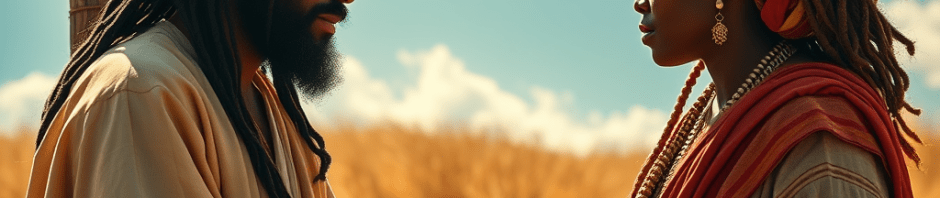
Jesus was on his way home from the feast of the Passover in Jerusalem. He goes through Samaria where the Jew’s cousins live. The Samaritans are Jewish but they have intermarried with other nations. The Jews do not like the Samaritans. They treat them as if they are nobodies. They consider them unclean. They would not sit with them at the same table to eat. Jesus comes to Samaria tired. It is midday. He stops at a well and the disciples go to get food in the nearby village.
A woman comes to the well at that same time. She comes alone which is unusual for a woman. In that culture women are always accompanied by someone. But this woman comes alone, to avoid the crowd.
Why?
You see, she carries within her, something that makes her want to separate herself from society. She no longer wants to talk to people because of the pain she carries within her. We see her admitting to Jesus that she has been unfortunate in love. In any society a woman like that is scorned. What we are not told is the story behind her having 5 husbands, and living with a man who is not her husband. It sounds like a very typical Jamaican relationship. In Jamaica if you live together for 5 or more years you have the same rights as a wife. But while many Jamaicans practice living together, even those who live like this do not believe it is right. We want you to be married. It gives status. The church wants the ideal for all of us, so it too looks down on these relationships. Why she has 6 husbands we will never know and if we ask women who have more than one ‘baby father’, we would not be surprised how sad the story is.
This woman with her jar approaching Jesus represents all the women and people in our lives on whom we look down.
She represents:
- The people we do not want to associate with because they will tarnish our good name.
- The people who, if we are friends with them nobody would speak to us.
- Somebody, who society says do not belong but all they can do is shun her.
- The person who we believe cannot come to the communion table and who we believe that one day the wine will choke them.
- The woman who is beaten by her husband and is afraid to leave him.
- The woman whose husband says she cant have friends, nor can she be seen speaking with anyone.
- The pregnant teenager, who parents tell their children not to be her friend because they don’t want their daughter to catch that particular disease.
- A member of the family whose name is in the newspaper and now nobody speaks to them.
- The girl who has had to fend for herself since she was twelve.
- The sixteen year old girl whose father has died and her stepmother puts her out, because she can no longer look after her.
- the young girl who has to leave home because she is old enough to find a man to look after her.
- Melissa Silvera, whose husband was allowed to plead to a lesser charge than murder.
- The woman who sprayed gas on the lady because that is what she had on hand to defend herself.
We are not deciding if these things are right or wrong. We are not making a judgment call. We are just highlighting bad situations, that women and girls find themselves in. The situations to which we turn a blind eye. When they come for help we pray for them but offer no assistance.
International Women’s day says we must Break the silence! Stop the violence!. It says they deserve more than prayers. They deserve the living water giving them life so they can rise from the ashes of injustice and their shame. Remember violence does not have to be physical it can be emotional. Because sometimes the things we say about people and to people hurt more than if you had taken a stick to them. We must remember that.
We Must Say No to conflicts and disagreements, no to misunderstandings.
We must say yes to talking. Yes to being honest about our feelings. Yes to listening how the other person feels. In any relationship, there must be an agreement on how you engage others. parents and children, husbands and wives. Teacher and student, brothers and sisters.
At the well, in the woman’s distress and unworthiness, Jesus meets her and listens to her. She feels comfortable and the spirit inside of him speaks to the spirit inside of her and she hears what he has to say. He knows who she is. He knows what she needs. Jesus does not pretend that there is no problem. Jesus doesn’t shame her, He meets her where she is, offering “living water.”
For women this living water is not just spiritual belonging, it is safety, dignity, being able to earn a decent wage, its about health care, reproductive rights – who owns your body, your husband or you, getting a good education or being able to make use of the opportunities we are given. These are the real challenges women face in life. Just as the woman said to Jesus I have none, our faith calls us to acknowledge the needs of others without judgment and to bring life-giving resources to them.
I have stressed women because of the day but our brothers and boys suffer just as much. The woman at the well is everybody who is ashamed of who they are. WE are called to have the compassion of Jesus. always putting ourselves in the victim’s shoes, always seeking the truth but not judging.
The woman is anyone we have shamed because of their circumstances. Her humanity is to be affirmed. Our humanity must always be affirmed. At all times we should look at others as we want others to look at us. Everybody is a somebody of importance You and I are somebodies. The children have a song, I am a promise I am a possibility. Each of us is a promise.
In this story we see the woman being redeemed. She recognizes that her past does not define her. She recognize that through what Jesus is offering, life for her will be better and can be better. She accepts Jesus’ offer. Jesus, even though he knew her story did not condemn her, instead, he offered an alternative lifestyle. Jesus’ response follows from the chapter before. John 3:16 says God so loved the world that he sent Jesus to save the world. But John 3:16 does not stand alone. Verse 17 says Jesus did not come to condemn. He came to save the woman and he is saving us now. In the story, Jesus shows, us how to live better, how to love, to be as he prayed in John 17: 21, to be one as he and the father are one. To be in one accord to be in fellowship with each other, to treat others as you want to be treated. That is what the woman at the well wanted. To be treated as being normal. It is what we want. It is what every single human beings wants – to belong to something greater than ourselves.
But you know what, as adults, as parents, as women who suffer and continue to suffer at the hands of a society which favours men, we have given up on ourselves. We have abdicated, or relinquished our responsibility to our women and girls. All must know that they are not lesser people than boys or men. They must understand that whatever the situation, no matter how hard it is, there is a way out. But that way comes through leaning on Jesus, spending time getting to know when he is speaking to you and following as he points you out of the situation.
The woman at the well was not ashamed of her need. She knew what was keeping her from participating, she knew what she needed and she asked for help. Jesus gave her what she needed.
Jesus’ action becomes our pattern for healing the brokenness inside of us. Jesus crossed boundaries to heal the woman. He was Jewish man, she a Samaritan woman, meeting at the public water source. They should not be speaking. He initiates a respectful conversation: he asks, listens, reveals truth gently. We still have women who live with being ashamed of who they are – skin colour – like our bleachers, poverty, the fact that they are tending to 40 with no husband, The gospel story challenges this. It says we, you and I must create spaces, where women’s voices can be heard, and treated with respect. WE must treat others as we want to be treated.
We cannot leave without acknowledging that we have made some progress as Jamaican Women. The World Economic Forum report of 2025 out of 148 countries ranks Jamaica #1 in educational attainment for women, due to high enrollment rates at primary, secondary, and tertiary levels. Our women outperform men in various education metrics. We are among the top 20 in the world in leadership and #8 participating in economic. Yet our women and children are still abused and ill treated. In a 2017 study Jamaica ranked second globally for the intentional killing of females. One in every four women experience physical or sexual violence in their lifetime, and nine out of every ten children experience violent discipline at home. How come? Why?
As persons who know the goodness of God’s grace, we must as Jesus did. speak truth that helps transform others. we must respond with honesty and growing faith because God’s grace works through truth-telling, not secrecy. We do not judge but we assist in seeking restoration and empowerment.
Like the woman at the well we must become witnesses. After encountering Jesus, the woman leaves her water jar and runs to tell others. she says come and see a man. Her testimony brings many to believe. We must pay attention to our women. when women lead, whole communities change. . Treat others as we want to be treated. we meet people who ever they are, where they are, we listen without judgment, we bring them into God’s life-giving truth, as we receive this living water, giving life we bring that life to others.
Today like the woman at the well Jesus is calling you and I to leave our past behind us and walk into the future with him. A future where there is no shame, where we stand tall. Where we understand that we are free to act like anybody else, free to receive what is duly ours as human beings. – respect and dignity. May we never forget that we are somebody.


 Hilda's journey